
Perimenopause Series Part 2: Estrogen Dominance – What It Actually Means and What It Does
“Estrogen dominance” is one of those phrases that gets thrown around constantly in the perimenopause world, and almost never explained properly. It can be genuinely confusing because it sounds like one thing but it is only partially true.
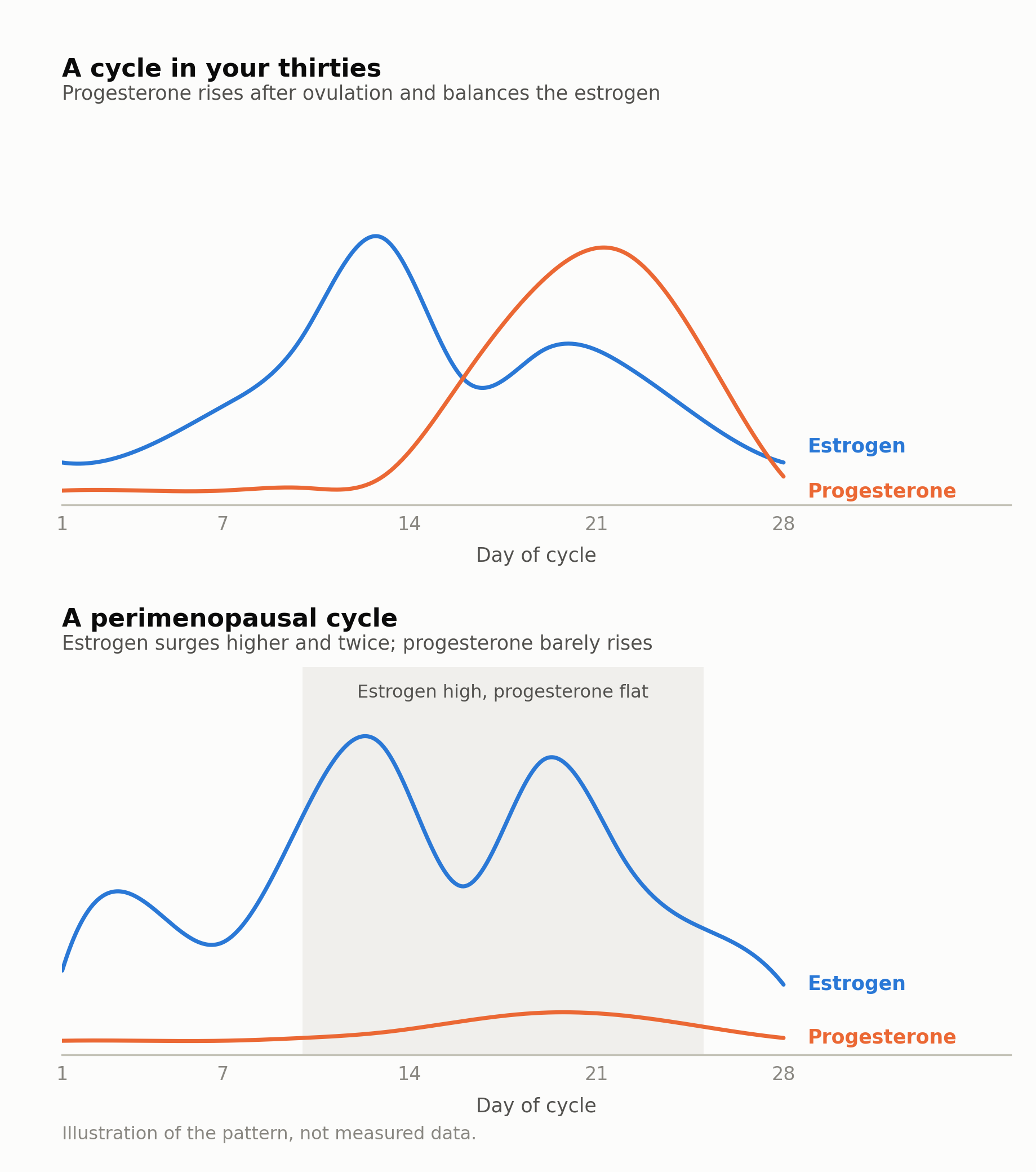
Here’s the setup, briefly. In perimenopause your estrogen doesn’t decline steadily the way we’re all told — it gets erratic, with surges that can push it well above where it sat in your thirties. Progesterone is the one that actually falls, and it falls earlier and more reliably. So you end up with estrogen spiking and crashing over a progesterone level that keeps dropping.
It’s worth knowing why progesterone is the one that drops, because nobody ever explained this to me and it makes the whole thing click. Progesterone is only made after you ovulate, by the structure the egg leaves behind. No ovulation that month means almost no progesterone that month. So as ovulation gets inconsistent — which is exactly what perimenopause does — you get cycles with barely any progesterone in them at all, while estrogen is still surging away.
That gap between the two is what people are pointing at when they say estrogen dominance. And the effects of it show up in places most of us would never connect back to hormones.
What the term actually means
Estrogen dominance describes a ratio, not an amount. Estrogen is high relative to progesterone — which can happen with high estrogen, normal estrogen, or even low estrogen, as long as progesterone is lower still. Perimenopause delivers both halves at once: estrogen surging while progesterone falls, so the gap widens from both directions.
It’s easier to see than to describe. Two cycles, same scale — one from your thirties, one from perimenopause.
It isn’t a formal medical diagnosis. There’s no blood test number that defines it and most gynecologists don’t use the term. But the pattern is real and well documented.¹
Perimenopause isn’t the only thing that widens the gap, either. Fat tissue makes estrogen of its own, so carrying more of it adds to your total. Alcohol raises circulating estrogen. And how well your gut moves determines whether estrogen your liver already packaged for disposal actually leaves or gets reabsorbed. None of that causes perimenopause, but all of it stacks on top it.
Why it looks like too much estrogen, not too little
This is the part that blindsides women. So many perimenopause symptoms look like too much estrogen rather than too little — heavy bleeding, breast tenderness, PMS that suddenly gets worse, fibroids growing. Women who’ve been told they’re running low on estrogen can’t square it, because their estrogen may genuinely be low, but compared to their progesterone it’s still high.
That’s the whole trick of the word “dominance.” It isn’t about the level. It’s about which one is winning.
One thing I’d say plainly about the bleeding, because it’s the part of this that can actually matter. Progesterone is what keeps the uterine lining in check; without enough of it, estrogen builds that lining unopposed. That’s why the bleeding gets heavy. It’s also why bleeding that’s very heavy, lasts a long time, or comes with clots is worth having looked at rather than waited out. Usually it’s exactly what it appears to be. Occasionally a lining that keeps building needs attention, and that’s an easy thing to check.
What the estrogen surges do on their own
Separate from the ratio, high estrogen does a few things progesterone has no say in. Two distinct ways that shows up in how you actually feel (but aren’t necessarily the only two).
It can lower your available testosterone. Estrogen raises a carrier protein called SHBG (Sex Hormone Binding Globulin), which binds testosterone in the bloodstream and takes it out of circulation. Bound testosterone can’t do anything. So during an estrogen surge, your free testosterone can drop even when your total testosterone hasn’t changed at all. Your labs look fine but you don’t feel fine.
Low available testosterone has a particular feel to it. Energy that doesn’t come back no matter how much you rest. Libido that can feel nonexistent. Reaching for a word you have used a thousand times and coming up empty. Walking into a room and losing the reason why you went in. Mostly it’s the sense of being a slightly dimmed version of yourself, without being able to point at any one thing that’s wrong. One aspect that really had me concerned was feeling like situations that I used to be able to handle emotionally were setting me off, and the upset could last for weeks. So many times the lack of testosterone gets misdiagnosed because providers aren’t even looking for it — another plug for finding the right provider.
It changes how your body handles fuel. This is one that gets waved off a lot of the time. Some classify it as your body holding onto weight because you’re eating too much, you’re too lazy, or you’re just letting yourself go, and it shouldn’t be. Hormones are wild, and if you don’t understand them it can feel so defeating.
The largest study to follow women through the transition tracked 1,246 of them for about sixteen years. Fat gain nearly doubled during perimenopause, from about 1% a year to 1.7% a year, while lean muscle went from slowly building to actively declining.
A separate study followed 156 women over four years. In the ones who crossed into menopause, fat oxidation — how efficiently the body burns fat for fuel — dropped by 32%, along with a measurable drop in the energy they burned at rest.³
This is where the testosterone piece from earlier connects back in. Muscle is expensive tissue — it costs energy just to exist — so losing it lowers what you burn at rest, before you’ve changed a single thing about how you eat or move. And testosterone is a big part of what holds muscle on you. So the same estrogen surges that bind up your free testosterone also make it harder to keep the muscle that keeps your metabolism running. Less free testosterone, less muscle, less burn, and the lower burn makes it easier to add the fat that produces still more estrogen. It’s a frustrating loop, and it can feel like you have no control over it. After putting on a random 20 lbs just because I hit that part of perimenopause was one of the things that pushed me into understanding it better so I knew what I could do about it.
So, like me, when a woman says her body started behaving differently and nothing about her eating or her workouts changed, she is describing something that shows up in the data. The number on the scale may not even move much at first, because muscle is coming down while fat is going up. What shifts is the composition. Which is a hormonal change, and not a willpower problem. Frustratingly, the slow decline also means it’s a slow incline. But there is hope and things you can actively do to try and reverse this breakdown.
So what do I actually do about it?
This isn’t a protocol and I’m saving the full detail for later in the series. But once you understand that the gap has two halves — estrogen on one side, progesterone on the other — the levers stop being mysterious. You’re either lowering one or protecting the other.
Protect ovulation, because that’s where progesterone comes from. Chronic under-eating, over-training, and running on very little sleep all suppress ovulation, and a cycle without ovulation is a cycle without much progesterone. This is the one place where “eat enough and rest” isn’t really a “you could try this” piece — it’s a critical part of keeping your hormones in check.
Progesterone, if it works for you. When your cycles have stopped producing much of it, replacing it directly is one option. Micronized progesterone is worth knowing about — it’s the same molecule your body makes, and it’s what most of the research on perimenopausal progesterone actually uses. This one gets its own section later in the series, because it deserves more than a bullet point.
It isn’t the only road, though, and for some women it isn’t a road at all. Some of us (like myself) react badly to supplemental progesterone — it can do the opposite of the calm it’s supposed to provide. Others can’t use hormones because of a cancer history. Neither one leaves you without options. It means your route looks different, and every other lever on this list still applies and I’ll share some suggestions in the next article.
Build and keep muscle. I can’t emphasize this one enough but please hear me when I say that working out everyday or pushing yourself too hard is going to do the opposite of what you want. Fat tissue makes estrogen, so reducing excess fat removes one of your estrogen sources — and muscle is what perimenopause takes from you, so resistance training works on both problems at once. But it’s the same trap as the ovulation point above: your body reads relentless training as one more stress, and it responds by protecting itself instead of building. Fewer, harder sessions with real recovery in between will get you further than grinding away daily. I’ll post a couple of workouts later that are built for this stage rather than for someone in her twenties.
Fiber, every day. Your liver packages used estrogen for disposal and sends it to your gut. Fiber binds it so it gets flushed out of your system. Without enough, some of the estrogen will get unpacked and reabsorbed back into circulation. If you’re constipated, that’s part of this picture, which iron supplementation (low ferritin is part of perimenopause) can exacerbate so make sure you’re getting extra.
Get your iron checked. Heavy or prolonged periods lose iron, month after month, and perimenopause is often when the bleeding gets heaviest. Low iron then produces almost exactly the picture women blame on hormones — exhaustion that sleep doesn’t touch, brain fog, hair shedding, a heart that races going up the stairs. Ask for ferritin specifically rather than a standard blood count, and know that the normal range runs wide enough that you can sit at the bottom of it and still feel terrible. One caution: don’t supplement iron without testing first. Too much iron is its own problem, and it isn’t something to take on a hunch.
Look honestly at alcohol. It raises circulating estrogen and adds to what your liver is already clearing. Maybe not a popular item on the list, but it is one of the most effective.
Cruciferous vegetables. Broccoli, cabbage, cauliflower, Brussels sprouts contain compounds that nudge estrogen down a gentler metabolic pathway.
Track your cycles. Not forever, but long enough to see your own pattern. When you can see which cycles are short, which are heavy, and where the bad weeks land, you stop guessing and you have something concrete to bring to an appointment. I’ll include a cycle tracker in the next article that makes it easy to access on the go from your phone or you can print it and fill it out as the months go by.
I’m not a doctor and this isn’t medical advice. Everything here overlaps with thyroid problems, anemia, and other treatable things — please get those ruled out with someone who can order the labs.
References
- Prior JC, Hitchcock CL. The endocrinology of perimenopause: need for a paradigm shift. Frontiers in Bioscience (Scholar Edition). 2011;3(2):474–486.
- Greendale GA, Sternfeld B, Huang M, et al. Changes in body composition and weight during the menopause transition. JCI Insight. 2019;4(5):e124865.
- Lovejoy JC, Champagne CM, de Jonge L, et al. Increased visceral fat and decreased energy expenditure during the menopausal transition. International Journal of Obesity. 2008;32(6):949–958.
You must be logged in to post a comment.